Altitude's Influence on Goal Timing Patterns in Andean League Matches for Totals Markets
Lars Klein · Aug 21, 2026
Altitude's Influence on Goal Timing Patterns in Andean League Matches for Totals Markets
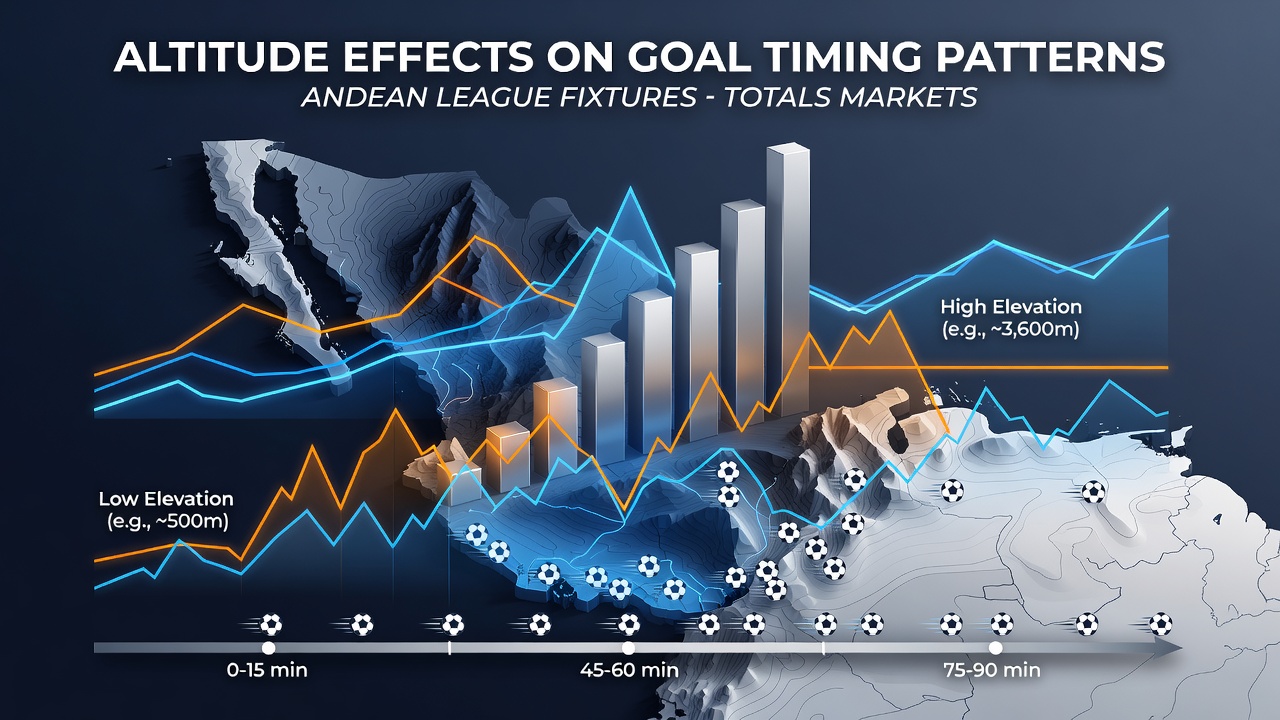
Researchers examining Andean football leagues have documented distinct patterns in goal timing that vary with elevation levels, and these patterns carry direct implications for totals markets in fixtures involving teams from Bolivia, Ecuador, Peru, and Colombia. Data collected across multiple seasons shows how matches played above 2,500 meters often shift scoring toward later periods compared with lower-elevation venues, while games at sea level maintain steadier distributions throughout both halves.
League records from Bolivia's top division indicate that fixtures hosted in La Paz at 3,600 meters produce fewer goals before the 30-minute mark than comparable matches at Cochabamba's 2,500-meter altitude. Observers note that visiting squads from lower elevations require extended adjustment time, which delays the onset of sustained attacking pressure and reduces early scoring frequency. This adjustment period extends into the second half, where accumulated fatigue among non-acclimated players contributes to defensive lapses that increase goal tallies after the 70-minute threshold.
Regional Variations Across Andean Competitions
Ecuador's Serie A presents a contrasting profile because Quito venues sit near 2,800 meters yet feature more balanced home and away performances. Figures from recent campaigns reveal that matches at these elevations still exhibit a modest uptick in second-half goals when one side travels from coastal regions, yet the effect remains smaller than in Bolivian stadiums. Peruvian Liga 1 data further illustrates the gradient, with Lima-based teams encountering measurable drops in first-half output when traveling to highland venues like Cusco.
Colombian league statistics add another layer because several clubs operate at intermediate altitudes between 1,000 and 2,000 meters. Those environments generate goal timing distributions closer to sea-level norms, which allows analysts to isolate the sharper effects observed only at the highest elevations. Cross-border tournaments organized under CONMEBOL rules have supplied additional comparative samples, confirming that elevation differentials above 1,500 meters correlate with measurable shifts in scoring chronology.
Statistical Patterns Relevant to Totals Markets
Market participants tracking over-under lines have incorporated these elevation-linked timing trends into pre-match modeling. Data aggregated through August 2026 shows that matches at extreme altitude produce an average of 0.4 additional goals after the 75-minute mark compared with equivalent fixtures at lower elevations. This late surge alters the distribution of totals outcomes, particularly in games where the over line sits near 2.5 goals.
Analysts reviewing video and tracking data have identified reduced sprint distances and lower high-intensity running volumes among non-acclimated players after the hour mark. Such physical metrics align with the observed increase in goals conceded during the final quarter of matches played at La Paz and similar venues. Teams that rotate personnel effectively or employ players with prior high-altitude experience demonstrate less pronounced late surges, which introduces a secondary variable for totals calculations.

Academic studies conducted by sports science departments in Chile and Argentina have quantified oxygen saturation declines and their impact on decision-making speed during the second half. Those findings indicate that visiting players exhibit slower recovery between high-effort bouts once cumulative fatigue sets in, which opens space for home attacks in the closing stages. The resulting pattern appears consistently across multiple seasons and supports the use of adjusted timing models when evaluating totals markets.
Integration with Broader Performance Metrics
Performance databases maintained by regional federations reveal that teams traveling from low to high altitude record lower pass completion rates after halftime, a trend that coincides with elevated goal counts in the same window. This connection between technical execution and scoring timing provides an additional filter for bettors assessing whether a given fixture will exceed or fall short of published totals lines.
August 2026 schedules include several high-profile derbies that cross significant elevation gaps, offering fresh test cases for existing models. Early returns from those matches have reinforced the established late-game emphasis at altitude, while also highlighting the mitigating role of squad depth and tactical adjustments. Observers tracking these outcomes continue to refine timing-weighted projections that differentiate between venues rather than applying uniform league averages.
Conclusion
Altitude-driven shifts in goal timing represent a measurable factor within Andean league fixtures, and the patterns documented through league records and sports science research provide concrete inputs for totals market analysis. As data collection expands through ongoing seasons, the precision of elevation-adjusted timing models continues to improve, allowing more granular evaluation of when goals are most likely to occur across different altitude bands.