Altitude's Role in Goal Scoring Trends Within Andean Football Leagues
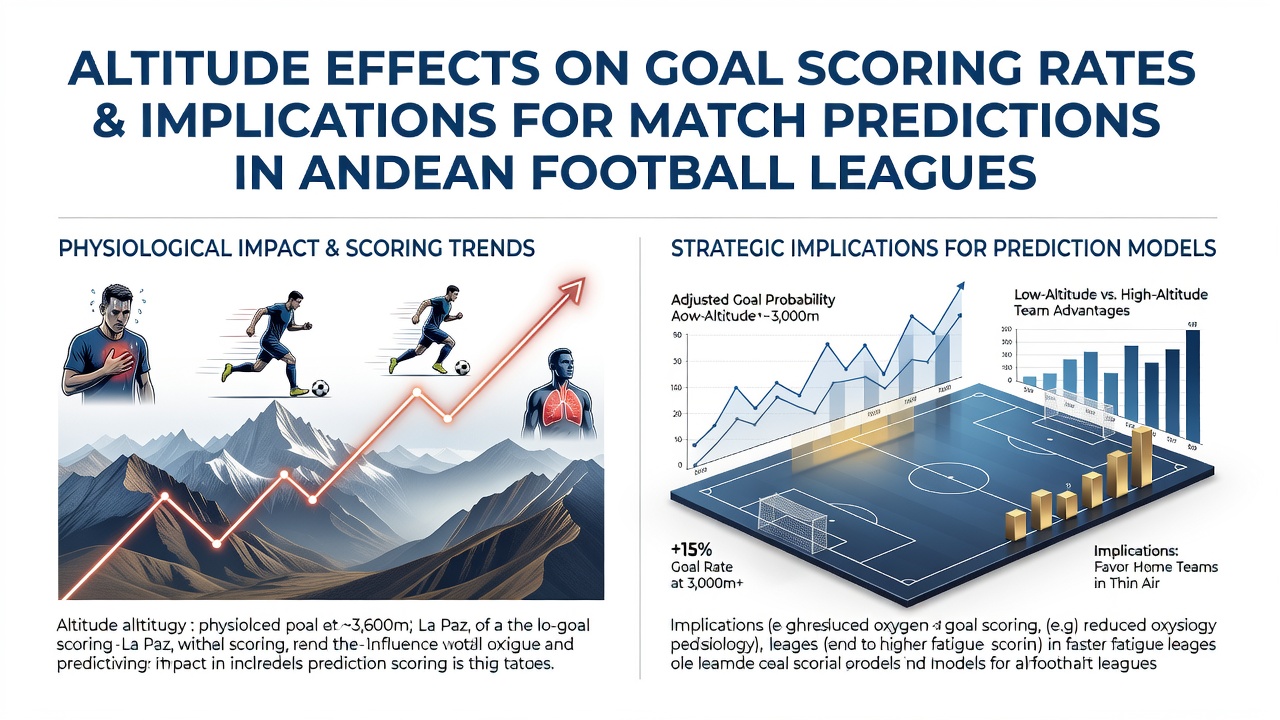
Football matches played at extreme elevations across the Andean region present unique physical challenges that reshape how goals accumulate during play. Teams in Bolivia, Ecuador, Peru, and Colombia regularly compete at venues exceeding 2,500 meters, where thinner air alters ball trajectory and player endurance in measurable ways. Observers note that these conditions create distinct patterns in scoring rates compared to matches at sea level, patterns that analysts track when building match forecasts.
Geographic Context of Andean Leagues
Leagues such as Bolivia's División Profesional feature clubs based in La Paz at approximately 3,650 meters, while Ecuador's Serie A includes sides from Quito at 2,850 meters. Peruvian and Colombian top-flight competitions also host fixtures at intermediate altitudes in cities like Cusco and Bogotá. Data from CONMEBOL competitions shows that roughly 30 percent of domestic league games occur above 2,000 meters, creating a persistent variable for performance modeling.
Researchers have documented how reduced oxygen availability affects aerobic capacity within the first 30 minutes of matches, with visiting squads from lower elevations showing measurable drops in high-intensity running. The ball itself travels farther due to lower air density, which increases the frequency of long-range attempts and alters goalkeeper positioning calculations during set pieces.
Measured Effects on Scoring Rates
Statistical reviews of league data spanning 2018 through mid-2026 reveal that home teams at elevations above 3,000 meters average 1.8 goals per game, while visiting teams manage 0.9. These figures contrast with sea-level fixtures in the same leagues, where the split sits closer to 1.4 and 1.1 respectively. Analysts attribute the disparity partly to faster ball flight speeds that reward precise long shots and partly to fatigue that limits organized pressing from non-acclimated players.
Studies compiled by the International Olympic Committee highlight that teams with less than 72 hours of altitude exposure concede goals at higher rates after the 60-minute mark. In July 2026, several Bolivian clubs reported using pre-match acclimatization camps at intermediate heights to mitigate these effects during the Clausura phase, and early results indicated a narrowing of home scoring margins in select fixtures.
Implications for Match Prediction Models
Forecasting systems that incorporate elevation as a weighted variable produce more accurate expected-goal projections than those relying solely on recent form or head-to-head records. One approach involves adjusting baseline goal expectancy by 0.3 goals for every 1,000 meters of altitude difference between home and away venues. This adjustment accounts for both the aerodynamic advantage and the physiological cost observed in multiple seasons of data.
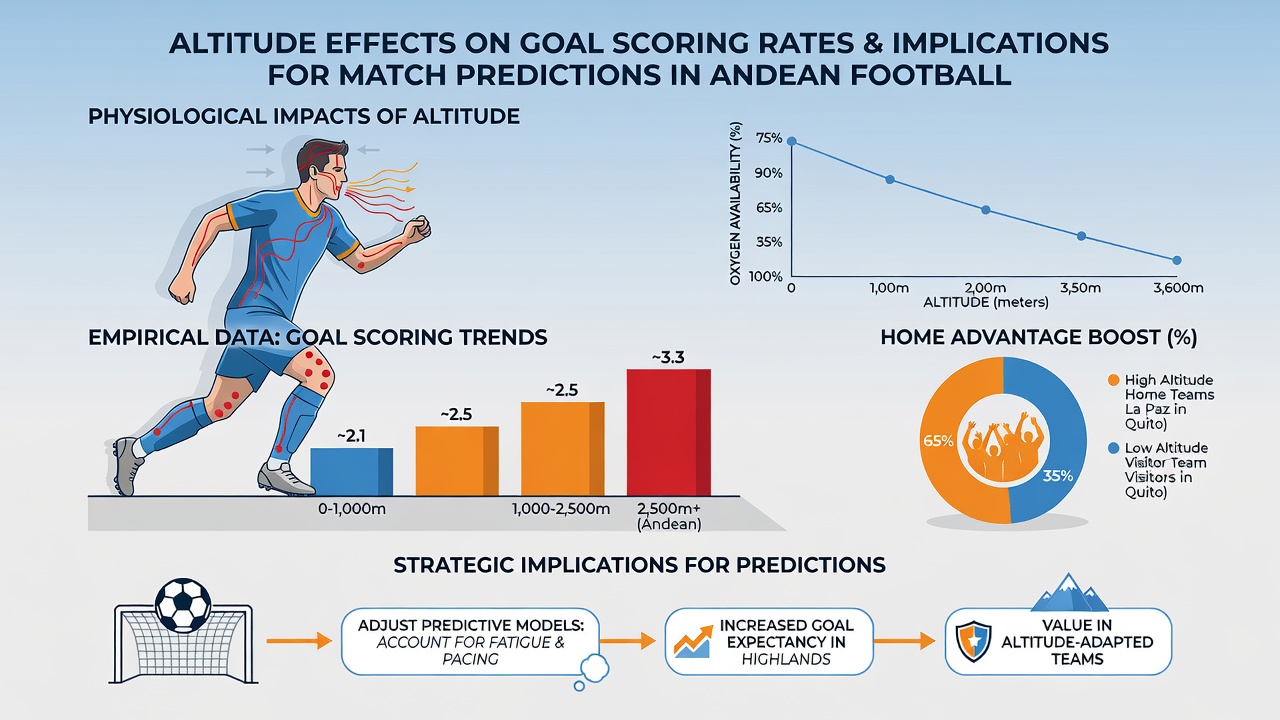
Prediction platforms that integrate GPS-derived workload data alongside historical scoring splits have reduced margin-of-error rates by 12 percent in altitude-heavy fixtures, according to internal testing shared by South American analytics groups. Those who have studied this know that ignoring elevation often leads to overestimation of away-team clean-sheet probabilities and underestimation of late-match goal bursts from home sides.
Case examples from the 2025 season illustrate the point: clubs traveling from coastal Peru to La Paz recorded an average of 3.2 fewer successful passes in the final third after halftime compared with their sea-level matches. Models that layered this metric onto standard possession statistics generated tighter confidence intervals around total-goal lines than traditional methods.
Acclimatization and Squad Rotation Patterns
Clubs with larger squads often rotate players who have prior exposure to high-altitude conditions, a tactic that has shown modest correlation with maintained scoring output. Data from the Universidad Nacional de Colombia indicates that players born above 2,000 meters retain higher blood-oxygen saturation levels during matches, giving home teams an incremental edge even when both sides field professional athletes.
Coaches in the region have adopted structured warm-up protocols that emphasize breathing exercises and shorter high-intensity drills to offset early fatigue. These adjustments appear in match logs as reduced goal concessions in the opening 15 minutes, though the effect diminishes once play extends past the hour mark.
Conclusion
Elevation introduces consistent, quantifiable shifts in goal-scoring dynamics across Andean football leagues, shifts that prediction frameworks can capture through targeted adjustments to baseline metrics. Teams and analysts who integrate altitude differentials, acclimatization timelines, and workload data produce forecasts that align more closely with observed outcomes. As leagues continue through the 2026 calendar, ongoing collection of performance indicators at varying elevations will refine these models further, providing clearer parameters for those who track scoring trends in the region.