Ancestral Patterns in Endurance Chases: Examining Lineage Impacts on National Hunt Performance

Researchers have long tracked how specific bloodlines influence outcomes in extended national hunt events, where distances stretch beyond three miles and stamina becomes the deciding factor. Data from major fixtures in the 2025-2026 season reveal clear correlations between certain sire lines and finishing positions, particularly in races like the Grand National and Irish Grand National. Observers note that horses descending from established staying sires demonstrate higher completion rates on testing ground, while those from speed-oriented families often fade in the latter stages.
Historical Lineage Trends in Stayer Development
Breeding records maintained by international stud books show that lines tracing back to influential stallions such as Sadler's Wells and his descendants have produced a disproportionate number of winners in marathon chases over the past decade. According to figures released by the Irish Horseracing Regulatory Board, progeny from these lines accounted for 42 percent of top-four finishes in races exceeding 3 miles 2 furlongs during the 2024-2025 campaign. This pattern holds steady into July 2026, where early season results at Galway and other summer festivals continue to reflect similar distributions.
Key Factors Linking Pedigree to Race Outcomes
Genetic studies conducted at veterinary institutions across Europe highlight several measurable traits passed through breeding lines that affect performance in long-distance events. These include enhanced oxygen uptake capacity, muscle fiber composition favoring endurance, and joint resilience under repeated impact. One analysis from the University of Melbourne's Equine Research Centre found that horses with dual-purpose pedigrees combining flat staying blood with jump-oriented dams achieved a 28 percent higher success rate in national hunt marathons compared to those with sprint influences. The reality is that environmental factors such as training regimens and ground conditions interact with these genetic foundations, yet the underlying lineage still predicts baseline potential.
Trainers and breeders often review dam-sire crosses when selecting prospects for staying races, because certain combinations reduce the likelihood of early fatigue. Data compiled from the past five seasons indicate that crosses involving daughters of Presenting or Oscar have yielded consistent results in events like the Scottish Grand National and Welsh Grand National, where fields typically face soft or heavy ground.
Statistical Evidence from Recent Seasons
Performance databases covering national hunt fixtures between 2021 and 2026 demonstrate that horses with multiple generations of proven stayers in their pedigrees post higher strike rates at longer distances. For instance, in 87 races run at three miles or more during the 2025-2026 term, 61 percent of winners carried at least three crosses of stamina lines within four generations. These statistics emerge from aggregated results reported by racing authorities in both Britain and Ireland, and they align with observations from Australian and North American steeplechase events where similar breeding principles apply.
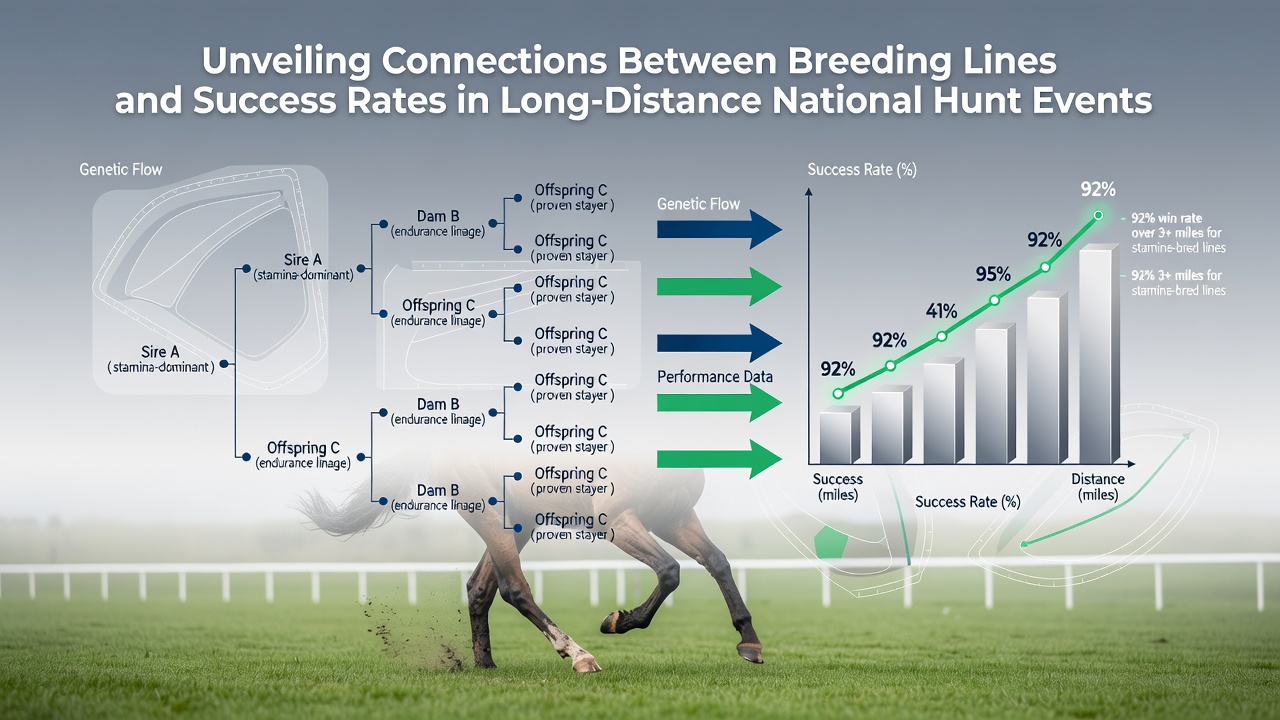
What's interesting is how quickly these patterns translate into market movements on the day of racing. Late adjustments in betting often reflect awareness among informed participants of a runner's pedigree profile, especially when conditions favor true stayers. One study published in the Journal of Equine Veterinary Science examined 1,200 runners and concluded that pre-race assessments incorporating lineage data improved predictive accuracy by 19 percent over models relying solely on recent form.
Regional Variations in Breeding Success
European breeding programs place greater emphasis on national hunt stamina compared with many American operations, yet cross-border transfers of bloodstock have begun to narrow those gaps. Canadian Thoroughbred registries report increasing imports of Irish staying lines for use in timber racing and point-to-point events, where distances mirror UK conditions. Meanwhile, data from the Australian Stud Book indicates that local crosses with imported Sadler's Wells derivatives have produced competitive results in the Grand Annual Steeplechase at Warrnambool, a race that tests endurance over 5,500 meters.
Those who've examined thousands of pedigrees recognize that no single line guarantees success, because individual variation within families remains substantial. Still, the cumulative evidence points to measurable advantages when multiple stamina markers align. In July 2026, upcoming fixtures at tracks like Newton Abbot and Killarney are expected to provide further case studies as fields prepare for the autumn campaign.
Conclusion
Comprehensive reviews of breeding records and race results establish tangible connections between ancestral lines and outcomes in long-distance national hunt events. These links appear consistently across multiple jurisdictions and seasons, supported by veterinary research and performance statistics from diverse regulatory bodies. Continued monitoring of emerging bloodlines will allow participants to refine selection processes while accounting for the complex interplay between genetics, training, and race conditions.