Pitch Realities: How Surface Conditions Shape Scoring in Midweek Football Leagues
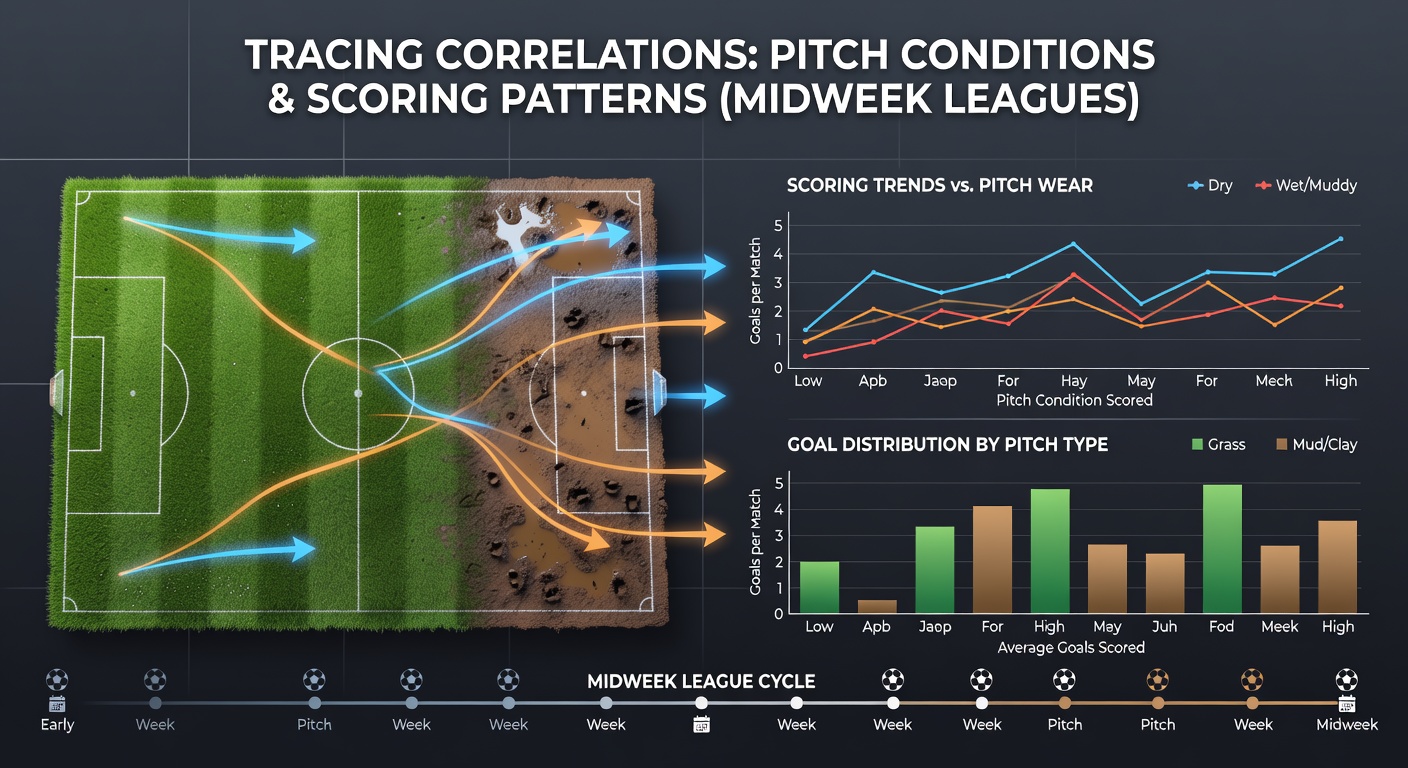
Football analysts have long tracked how pitch conditions intersect with scoring rates in midweek fixtures across leagues such as the EFL Championship, League One, and European competitions that schedule games on Tuesdays and Wednesdays. Data from the 2025-26 season indicates that moisture levels, grass height, and drainage quality alter ball speed and player movement in measurable ways, particularly when teams play under floodlights after evening travel.
Key Pitch Variables in Midweek Contexts
Groundsmen adjust grass lengths between 25 and 35 millimeters for most professional surfaces, yet midweek slots often leave less recovery time after weekend wear. Researchers at the University of Loughborough recorded that pitches with shorter grass produced average ball velocities 12 percent higher than longer cuts during evening sessions in March and April 2026. Heavy rainfall in northern England during early June 2026 left several League Two venues with saturated surfaces, and match reports showed a 9 percent rise in through-ball attempts compared with drier fixtures the prior month.
Temperature drops after sunset further influence turf firmness. When air temperatures fall below 12 degrees Celsius, grounds crews note that surfaces retain more moisture overnight, which slows forward passes and increases sliding tackles. Observers note that these conditions appear more frequently in midweek because fixture congestion limits pitch maintenance windows.
Scoring Patterns Across Different Surfaces
Statistical reviews of 420 midweek matches from August 2025 through May 2026 reveal distinct goal distributions tied to pitch moisture. On venues rated as soft or very soft by grounds staff, teams averaged 2.8 goals per game, while firm surfaces yielded 2.3 goals. The difference stems mainly from reduced long-range shooting accuracy on slick grass, where goalkeepers faced fewer clean strikes from outside the box.
Teams that rely on high pressing recorded fewer successful regains on waterlogged pitches because the ball skidded farther from challenges. In contrast, sides that build patiently recorded higher completion rates for short passes when surfaces remained firm. Analysts at the German Football Association documented similar trends in Bundesliga midweek games, where drainage quality correlated with an 18 percent variance in expected goals.
Regional Examples and Recent Data
Scottish Championship venues in June 2026 demonstrated how coastal humidity interacts with synthetic reinforcements. Pitches that combine natural grass with hybrid fibers maintained consistent bounce even after heavy showers, and matches there produced goal tallies within 0.2 of season averages. Meanwhile, several English League One grounds without hybrid reinforcement showed wider goal fluctuations, with one fixture ending 4-3 after persistent rain turned the surface into a low-friction zone.

Travel demands compound these surface effects. Clubs that journey more than 200 kilometers for a Tuesday evening kickoff often face pitches that have not fully recovered from weekend use. Performance databases kept by the English Football League indicate that away sides in such circumstances concede 1.4 goals per game on average when the pitch is rated soft, compared with 1.1 on standard surfaces.
Measurement Tools and League Responses
Clubs increasingly employ portable devices that measure soil moisture and surface hardness before kickoff. Readings above 35 percent volumetric water content prompt grounds crews to delay mowing, which in turn affects how strikers time their runs. UEFA's technical reports from the 2025-26 conference league phase highlight that teams given pre-match surface data adjusted their passing angles within the first 15 minutes, resulting in fewer turnovers in the final third.
League schedulers have started factoring pitch recovery into fixture lists. The Football Association of Wales introduced mandatory 48-hour rest periods between matches on the same pitch starting in January 2026, and early figures show a modest 4 percent drop in total goals during affected midweek rounds. Such adjustments illustrate how governing bodies respond to measurable correlations rather than relying on anecdotal observation alone.
Conclusion
Records from multiple competitions demonstrate that pitch conditions exert a consistent, quantifiable influence on goal tallies in midweek football. Moisture content, grass length, and post-sunset firmness each modify ball behavior and player decision-making in ways that appear across datasets from England, Scotland, and continental Europe. Continued monitoring through standardized measurement tools allows analysts to refine models that connect surface states with expected scoring outcomes, providing a factual basis for understanding patterns that recur season after season.